Use your Discount Code


New vs. Used Printing Equipment: What Buyers in the Gulf Should Know Before Purchasing
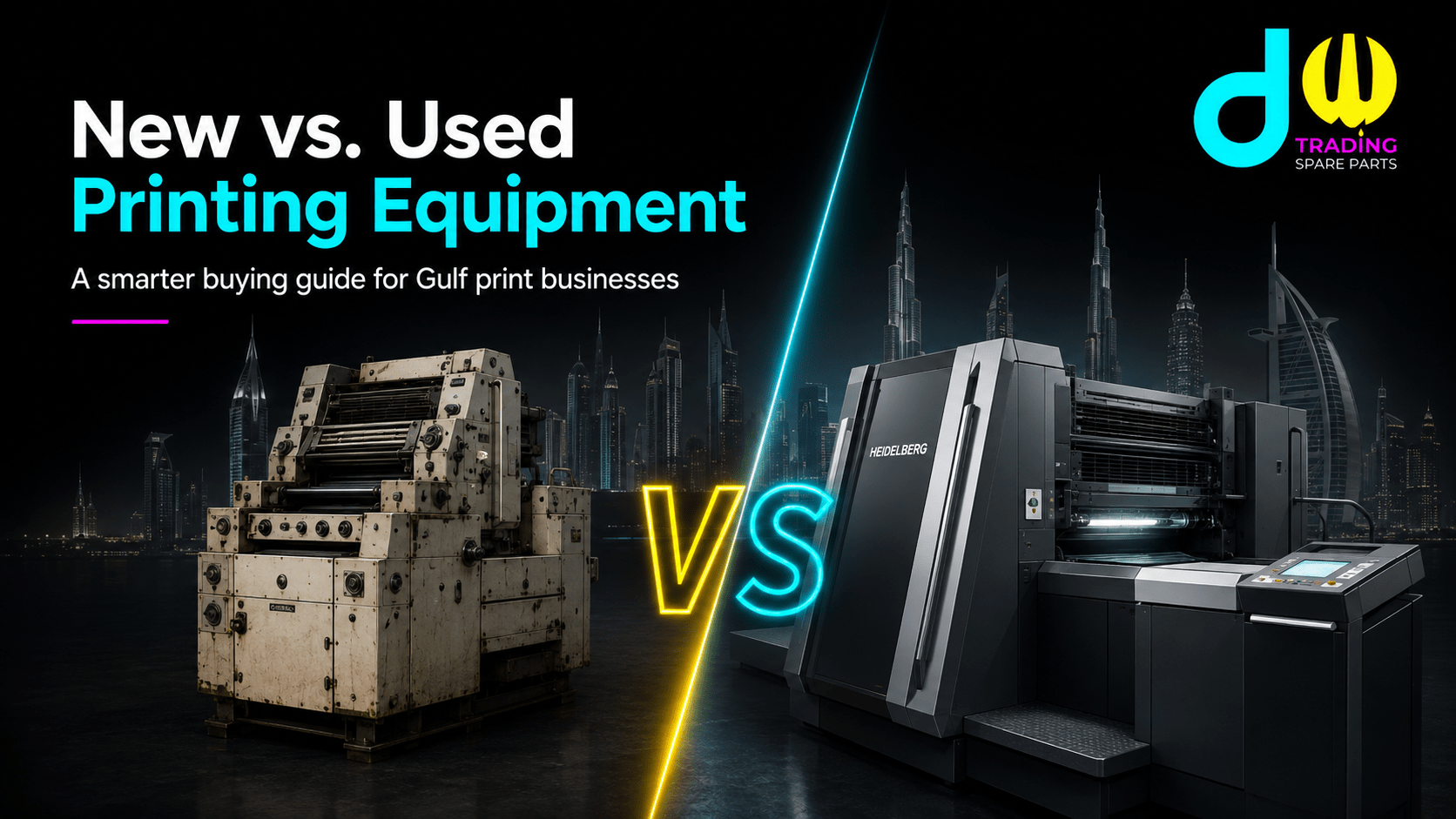
The Gulf’s printing industry is growing — and fast. Whether you’re setting up a commercial print shop in Dubai, scaling a packaging operation in Riyadh, or expanding finishing capacity across the GCC, one question keeps coming up before any major purchase: should I buy new or used?
It’s not a simple answer. The right choice depends on your production volumes, capital position, technical support access, and growth timeline. This guide walks you through the key considerations so you can make a decision that holds up — not just on paper, but on the shop floor.
—
The Gulf Print Market Is Growing: Context Matters
Before comparing equipment options, it helps to understand the environment you’re buying into.
The UAE printer market is currently valued at USD 1.7 billion, and the UAE digital printing segment alone is projected to reach USD 2.5 billion by 2030, growing at a 7.5% CAGR (Ken Research). Across the broader GCC, the digital printing market is forecast to reach USD 1.36 billion by 2031, at a CAGR of 8.78% (Mordor Intelligence, 2026).
This isn’t background noise — it’s buying context. A growing market means:
• Demand for faster turnaround and higher volumes
• Greater pressure to invest in technology that keeps you competitive
• More second-hand equipment entering the market as regional printers upgrade
The commercial printing segment in the UAE generated USD 4.4 million in revenue in 2025 and is expected to reach USD 5.8 million by 2033, growing at 3.6% annually (Grand View Research). Lithography remains the largest revenue-generating printing technology in the region, while digital printing is the fastest-growing segment. Both markets are active, and both require capital-efficient purchasing decisions.
Concrete signs of regional investment are everywhere. In September 2024, Tenaui inaugurated what it described as the largest digital commercial printing press in the Middle East, based in Riyadh — a facility capable of handling up to 10 million prints per month, serving everything from books and magazines to commercial brochures. And Gulf Print & Pack 2025, held for the first time in Saudi Arabia at the Riyadh Front Exhibition & Conference Center in January 2025, drew over 150 exhibitors including Canon, Fujifilm, Konica Minolta, Bobst, and Ricoh — a clear signal of where regional investment attention is pointed.
The printing industry in the Gulf is not contracting. Buyers are entering a market that rewards smart capital allocation.
The Core Trade-Off: What New Equipment Actually Gives You
New equipment has a clear value proposition. You know exactly what you’re getting: full manufacturer warranty, the latest firmware and automation features, factory-calibrated color management, and a clean maintenance history. For buyers with predictable high-volume production needs, tight quality tolerances, or long-term service contracts with major clients, new machinery removes a category of operational risk entirely.
There are also financing structures that make new equipment more accessible than its sticker price suggests. OEM financing, leasing, and deferred payment options are increasingly available in the Gulf market, particularly for established commercial printers with solid balance sheets.
When New Makes Sense
• You’re building a facility from scratch and need everything under warranty
• Your production environment demands the latest digital automation (inline finishing, real-time color calibration, cloud-based job management)
• You have a manufacturer or regional distributor with strong local support infrastructure
• Downtime costs more than the capital saved on a used machine
The honest limitation of new equipment is simple: it’s expensive, and in a region where the cost of capital matters and many print businesses are mid-scale operations, the price difference between new and quality used machinery is often hard to justify — especially when the used alternative is a Heidelberg, Komori, or Mitsubishi built to outlast most modern equivalents.
The Case for Used: Where the Real Value Lives
Buyers who do their due diligence on pre-owned printing equipment can save 40 to 70 percent compared to buying new — without necessarily accepting any meaningful reduction in print quality or operational lifespan (Alibaba SmartBuy Buying Guide).
That’s not a marginal difference. On a piece of equipment priced at USD 200,000 new, you could be looking at USD 60,000 to USD 120,000 in savings — capital that can be deployed into skilled operators, consumables, additional capacity, or marketing.
The reason this works is straightforward: certain manufacturers build machines that simply don’t wear out quickly. Heidelberg offset presses, Komori lithographic machines, and Mitsubishi printing systems have decades-long reputations for mechanical durability. A well-maintained Heidelberg Speedmaster with documented service history can run reliably for years after its first owner has upgraded and moved it on. The same applies to print finishing equipment from Kolbus, Müller Martini, MBO, and Polar-Mohr — brands whose machines hold their mechanical integrity through multiple ownership cycles.
What Makes a Used Machine Worth Buying
Not all used equipment is equal. The difference between a smart purchase and a costly mistake comes down to a few specific factors:
Documented maintenance history. Any reputable supplier should be able to provide service records. If they can’t, walk away. A machine without records is a machine with unknown risk.
Inspection before purchase. For high-value equipment, arrange a physical inspection — either in person or through a trusted third party. Check impression cylinders, blanket condition, ink roller durometer, and registration systems. On digital equipment, check drum condition, fuser unit life, and print head hours.
Spare parts availability. This is where Gulf buyers specifically need to think carefully. A great machine at a great price becomes a liability if spare parts are unavailable locally or require months to import. Before purchasing any pre-owned press, confirm that spare parts can be sourced reliably — and affordably — in your region.
Seller credibility and after-sale support. Is the seller just moving inventory, or do they understand printing equipment well enough to stand behind what they sell? The difference matters enormously once the machine is installed and something needs attention.
The Spare Parts Question: A Gulf-Specific Consideration
This point deserves its own section, because it’s the one that turns a good deal into a bad one most often in the Gulf market.
Infrastructure for printing equipment support in the region has improved significantly, but it remains uneven. Major OEMs have dealer networks in the UAE and Saudi Arabia, but coverage thins out as you move into smaller markets. And for pre-owned equipment — particularly older offset presses, large format machines, or specialist finishing lines — you are often operating outside the OEM’s active support window.
This means your supply chain for consumables and wear parts becomes your responsibility.
Buyers who don’t account for parts availability at the point of purchase often face two problems: extended downtime waiting for international shipments, and inflated costs when parts are sourced through intermediaries with no real expertise in the equipment.
The smarter approach is to treat spare parts supply as part of your purchasing decision — not an afterthought. If you’re buying a used Heidelberg or a pre-owned large format press, establish your parts source before the machine arrives. Know what the wear components are, how frequently they need replacing, and whether you can get them from a supplier who understands the machine.
Digital vs. Offset: Does the New/Used Question Change?
Yes — and it’s worth addressing directly.
For offset lithographic presses, the used market is mature, well-understood, and full of genuinely excellent machines. The technology is decades old, the engineering is proven, and the service community is large. A well-specified used offset press from a trusted brand is often a straightforward, low-risk purchase for buyers who know what they’re evaluating.
For digital printing equipment, the used market requires more caution. Digital presses are more dependent on software, firmware, and manufacturer support ecosystems. An older digital press that’s out of active support from the OEM may face challenges with driver compatibility, color profile updates, and increasingly, substrate media that modern production environments require. This doesn’t mean used digital equipment is a bad purchase — but it means the due diligence needs to include a specific check on manufacturer support status.
Large format printing — a significant segment in Dubai and across the Gulf given the demands of retail, hospitality, exhibition, and outdoor advertising industries — presents its own considerations. Large format inkjet systems age primarily through print head wear and ink system condition. Both are assessable, and both are manageable if you have a spare parts source you trust.
A Practical Framework Before You Buy
Whether you’re leaning toward new or used, run through these questions before committing:
1. What are my realistic monthly volume requirements for the next 24 months? New equipment is easier to justify at higher sustained volumes. Used makes more sense if you’re building capacity incrementally.
2. What’s my true total cost of ownership? Purchase price plus installation, operator training, consumables, maintenance contracts, and parts. New equipment often has lower ongoing costs; used can have lower entry costs but higher parts variability.
3. Who will service this machine in my market? For new equipment: what’s the OEM’s service response time in my region? For used: who supplies parts, and how quickly?
4. What’s my downtime tolerance? A press that’s down for a week waiting on parts from Europe has a real cost. Factor that into your risk assessment.
5. Is the seller credible? Can they provide machine history, answer technical questions, and support you after the sale — or are they simply moving inventory?
The Bottom Line
There’s no universal answer to the new vs. used question. A well-sourced, properly inspected used Heidelberg or Komori can outperform a budget new machine in total value delivered over five years. And for buyers entering the Gulf market’s growing digital print segment, a new press with full OEM support may be the right foundation for a long-term commercial operation.
What matters is making the decision with accurate information — about the machine, about your market, and about the supply chain behind it.
At Druk Widasla, we work with print businesses across the Gulf to source quality pre-owned printing and finishing equipment, and to keep machines running through reliable spare parts supply. Our team understands the equipment — not just the transaction — and we’re built to support buyers in this region specifically.
If you’re evaluating a purchase or trying to understand your options, get in touch with the Druk Widasla team. We’ll give you a straight answer.
Post Widget